
BOOK
0
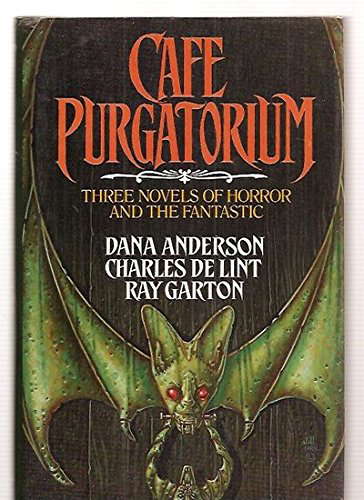
Three novels tell of love and horror beyond the grave, cruel and unusual punishment for a child abuser, and a dead man forced to choose between equally terrifying alternatives
Imaginative and moving, the three horror novellas collected here outline the redemptive powers of love. In "Cafe Purgatorium" by newcomer Anderson, a man falls in love with a dead woman who comes alive at night in the cafe where he lives. She is one of a group of people who died on the premises and who now return with darkness to dance and drink till dawn. Unable to endure existence without his inamorata, the suitor eventually makes a bargain with Satan. The couple in Garton's ( Live Girls ) "Dr. Krusadian's Method" isn't offered a choice. If the two do not cooperate with the good doctor, they will face imprisonment for abusing their son. After Krusadian gives them a taste of their own medicine, they begin to wish for death rather than deal with him. Death seems imminent for the young protagonist of "Death Leaves an Echo" by de Lint ( The Little Country ) as he careens off a highway. He wakes up from a dream, however, to find that his cherished wife and all her things are missing. As everyone around him denies her existence, he continues his search, watching helplessly as the threads of his life begin to unravel. Each of these works speaks to the importance of love in shifting the balance of power between the forces of good and evil. Copyright 1991 Reed Business Information, Inc.
Three original novellas make a strong case for the vitality of fantasy's more macabre side. Anderson's "Cafe Purgatorium" tells a bittersweet story of a ghostly lover, a haunted dance hall, and a deal with the devil. In "Dr. Krusadian's Method," Ray Garton explores a unique and unforgettable cure for child abuse. "Death Leaves an Echo" brings Charles de Lint's gentle style to a dying man's struggle to choose between worlds. Purchase where there is a demand for horror of the subtler, non-splatter variety.Copyright 1991 Reed Business Information, Inc.
``Three original novels of horror and the fantastic'' claims the publisher in its catalogue and galley copy. Well, not quite. It turns out that these are novellas, not novels; and, more importantly, the longest work here--Garton's ``Dr. Krusadian's Method''--appeared in his Methods of Madness collection (1990). Moreover, the quality here is, at best, just a cut above 1950's pulp--and that's in the last and shortest novella. Readers must first slog through Anderson's lumpy title story, in which a man buys a haunted nightclub, learns that the souls therein are coveted by Lucifer, and does bloody battle with His minions, winning with the same principle that allowed the Little Engine to go up the hill. As short-story writer Anderson's longest published work, this bodes poorly; Garton, whose ``Dr. Krusadian's Method'' comes next, can at least fall back on having written one of the wittiest of splatterpunk novels, Live Girls (1987 paperback). Here, in a yarn about an occult cure for child abuse, the splatter is in full force, if not the wit. More appealing is de Lint's ``Death Leaves an Echo,'' in which this prolific mass-market fantasist (Jack the Giant Killer, 1990, etc.) spins a catchy premise--a man wakes up to find every trace of his wife gone from the world--and embroiders it inventively. The revelatory climax lacks the drama of the premise and is preceded by some gratuitously graphic sex, but, overall de Lint spools out a smooth and satisfying yarn. Skip the Anderson, rip out the Garton, you're left with one decent novella--for $18.95? -- Copyright ©1991, Kirkus Associates, LP. All rights reserved.
Find it on
AmazonNo videos available yet.
No news articles linked to this title yet.

Overall
Overall rating of the media
Atmosphere
How immersive and tense is the atmosphere
Gore
Level and quality of gore/violence
Story
Quality of the storyline and plot
Writing
Quality of the written content
Character Development
Depth and growth of characters
Pacing
Flow and timing of the narrative