
BOOK
0
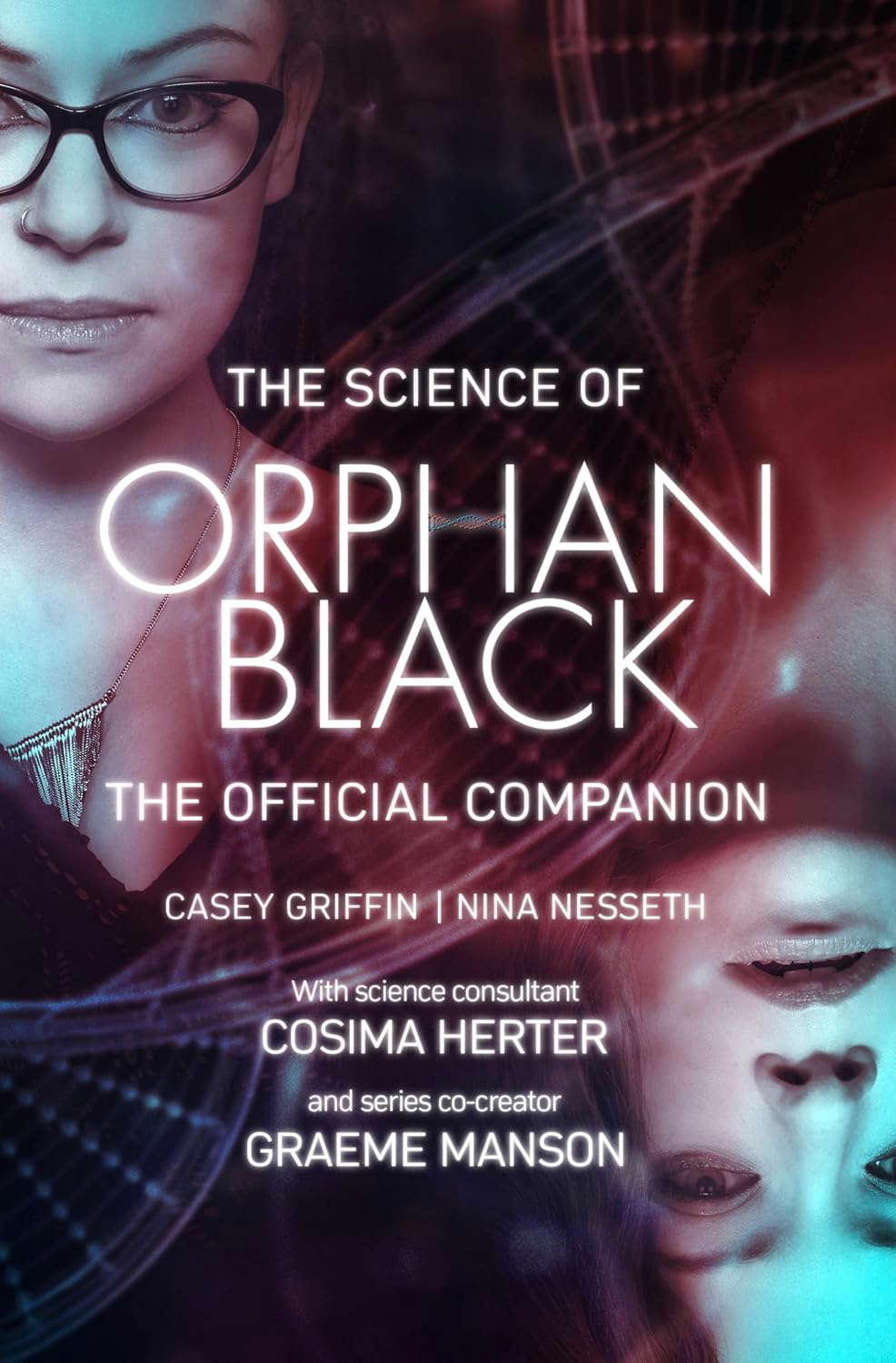
An official guide to the crazy science of Orphan Black Delve deeper into the scientific terms and theories at the core of the Peabody-winning, cult favourite show. With exclusive insights from the show’s co-creator Graeme Manson and science consultant Cosima Herter, The Science of Orphan Black takes you behind the closed doors of the Dyad Institute and inside Neolution. Authors Casey Griffin and Nina Nesseth decode the mysteries of Orphan Black — from the history of cloning, epigenetics, synthetic biology, chimerism, the real diseases on which the clone disease is based, and the transhumanist philosophies of Neolution, to what exactly happens when a projectile pencil is shot through a person’s eye and into their brain.
The official guide to the crazy science of Orphan BlackWith exclusive insights from the show's co-creator Graeme Manson and science consultant Cosima Herter, The Science of Orphan Black takes you behind the closed doors of the Dyad Institute and inside Neolution. Authors Casey Griffin and Nina Nesseth decode the mysteries of Orphan Black; from the history of cloning, epigenetics, synthetic biology, chimerism, the real diseases on which the clone disease is based, and the transhumanist philosophies of Neolution, to what exactly happens when a projectile pencil is shot through a person's eye and into their brain. In full color, this must-have companion to the Peabody Award winning show covers all five seasons and includes a foreword by the "Real Cosima."
The official guide to the crazy science of Orphan BlackWith exclusive insights from the show's co-creator Graeme Manson and science consultant Cosima Herter, The Science of Orphan Black takes you behind the closed doors of the Dyad Institute and inside Neolution. Authors Casey Griffin and Nina Nesseth decode the mysteries of Orphan Black; from the history of cloning, epigenetics, synthetic biology, chimerism, the real diseases on which the clone disease is based, and the transhumanist philosophies of Neolution, to what exactly happens when a projectile pencil is shot through a person's eye and into their brain. In full color, this must-have companion to the Peabody Award winning show covers all five seasons and includes a foreword by the "Real Cosima."
The Science of Orphan BlackThe Official CompanionBy Casey Griffin, Nina NessethECW PRESSCopyright © 2017 Casey Griffin and Nina NessethAll rights reserved.ISBN: 978-1-77041-380-1ContentsFOREWORD by Cosima Herter, INTRODUCTION: Welcome to the trip, CHAPTER ONE: "How many of us are there?", CHAPTER TWO: "There's only one of me", CHAPTER THREE: "You're just a bad copy of me", CHAPTER FOUR: "This is my biology, my decision", CHAPTER FIVE: "My poor, poor Rachel", CHAPTER SIX: "Your little girls are dying", CHAPTER SEVEN: "And we, here, shall drink from the fountain first", THE CONVERSATION: Graeme Manson and Cosima Herter, Glossary, Orphan Black and History: A Timeline, Selected Bibliography, Acknowledgments, About the Authors, Copyright, CHAPTER 1"HOW MANY OF US ARE THERE?"THE HISTORY & SCIENCE OF CLONESImagine that you are Sarah Manning. You are standing on a train station platform late one night when something catches your eye. It's a woman and her back is turned to you. The woman takes off her suit jacket, folds it, and places it on the platform. She slips off her heels. She turns around.The woman is identical to you. Wearing nicer clothes, granted, but her face? The spitting image.Before you can get any answers, the woman has stepped out in front of a moving train. She's gone. Dead. You're an orphan and have never known your family. Your best guess — after stealing her purse and riffling through her things — is that this woman, Elizabeth Childs, must be your long-lost twin sister.SARAHWhat the hell, Fee? Did I have a twin sister?FELIXWell, when you're a poor little orphaned foster wretch, anything's possible. Or so we tell ourselves.(1.01 "Natural Selection")It doesn't occur to Sarah Manning that "anything's possible" could include clones, and despite seeing Beth, and then meeting Katja, and then Alison and Cosima, the thought still doesn't occur to her. It takes a frustrated Alison blurting out that she, Cosima, and Sarah are all clones, all somebody's experiment, for the message to finally get across (although Cosima really wanted to float that whole clone thing a lot softer). But really, why should it have been obvious to Sarah that she was a clone? Human cloning is illegal, for one, and there is no record of a cloned human surviving past an embryonic stage, let alone into adulthood. The most famous clone — Dolly the sheep — was born in 1996. For Sarah, who is 28 years old in season one, to be a clone suggests that there was a much bigger cloning project happening more than a decade earlier in the 1980s. Is that unrealistic? Not really. Dolly may be a famous clone (for reasons we'll explain later), but she definitely wasn't the first.First off, let's be clear about what we're talking about when we're talking about cloning. There's a whole world of possibilities for cloning out there other than just straight up creating identical copies of a being. We can clone on the tiniest scale and make copies of, say, fragments of DNA. This is known as molecular cloning. Then there's cellular cloning, which creates populations of identical cells from a single cell source. Cloned cells can be used for research (especially stem cell research) or to grow tissues. A really exciting aspect of cellular cloning is therapeutic cloning, which uses cloned cells for medical research, treatments, and transplants. And then, of course, there's organism cloning — known as reproductive cloning — by which we can create whole organisms that are identical to an original "parent" organism. With Orphan Black, we're talking about reproductive cloning: creating complete living, breathing, genetically identical humans. We're talking about Sarah Manning. About Beth Childs. About Cosima Niehaus, and Alison Hendrix, and Rachel Duncan, and all of the clones that we've met over five seasons. We know that they are all (save for Charlotte Bowles) from a single generation of clones, born in the 1980s thanks to the efforts of professors Ethan and Susan Duncan and their research team at the Dyad Institute (including one religious extremist research assistant by the name of Henrik Johanssen). The cell line that gave rise to these clones came from a tissue sample from a woman named Kendall Malone, and a second tissue sample yielded clones for a second project, Project Castor, headed by the military. Ethan Duncan alludes to the ethical and biological challenges of cloning a human being, but he only scratches the surface of what a secret illegal international science experiment such as these would entail. In reality, the history of clones and cloning has been and continues to be filled with hurdles and controversies.We meet the "father" of Project Leda, Ethan Duncan, in season two — a season full of examinations of scientists of different experiences, worldviews, moral backgrounds, and motivations — and as a way of weaving in the scientific themes of Orphan Black, Graeme Manson and Cosima Herter fittingly chose episode titles pulled from the works of Sir Francis Bacon. Sometimes referred to as the "Father of Experimental Philosophy," Francis Bacon was an English scholar in the late 16th and early 17th centuries who focused most of his work on philosophical and scientific ideas, most notably the development of the scientific method. The scientific method is a process of inquiry that involves developing a hypothesis based on observations and testing this hypothesis through experimentation. This, of course, ties into Orphan Black in that the clones came about as a result of experimentation based on laboratory observations and the hypothesis that human cloning was possible. Bacon's emphasis on inquiry and induction is mirrored by Ethan's work, making it a good match for the second season. Bacon also wrote many works focused on philosophy and religion, and particularly on morality. Once again, this dovetails perfectly with a season in which we meet the Proletheans and examine their questionable practices in the name of a higher power.Interestingly, Bacon's Novum Organum, published in 1620, is a philosophical work discussing a new system of logic Bacon deemed superior to syllogism. We see syllogisms in Orphan Black during season three, as a means of testing the Castor clones for signs of "glitching." Bacon's work, specifically his focus on discussing ways to improve mankind, also mirrors themes brought up in season four. He touched on topics such as prolonging life, reforming law, and scientific innovation.Aside from his academic writings, Bacon also wrote a novel, New Atlantis, which falls into the category of utopian-philosophical writings. While the plot is thin and the writing itself reads like an oven instruction manual, New Atlantis describes a location known as Salomon's House, a centrally organized research facility with the purpose of collecting data, conducting experiments, and using knowledge to improve the outside world. Sounds a bit like some of the centers on Orphan Black. Essentially, this novel set the stage for modern research centers and scientific communities, providing the blueprint for the likes of the British Royal Society, the National Institutes of Health, the Dyad Institute, and Revival.HOW TO CREATE A CLONECloning actually has botanical roots. The word "clone" is derived from the Greek [TEXT NOT REPRODUCIBLE IN ASCII.] (klon), which translates to "twig." In 1903, Dr. Herbert J. Webber, a plant physiologist for the U.S. Department of Agriculture, adopted the word (he spelled it "clon") to describe the process of taking a graft, or cutting, from a plant and using it to propagate new plants asexually. To Webber, these cloned plants "are simply part of the same individual." Eventually, the term expanded to include all forms of asexually produced life, but for a long time it was used only in the field of agriculture.Let's fast-forward to 1952, some 45 years before Dolly was introduced to the world and close to 30 years before Dyad was working on Project Leda. In that year, two scientists, Robert Briggs and Thomas King, cloned frogs from tadpole cells, using a low-tech cloning technique known as embryo twinning, which basically mimics how identical twins are formed in nature. Very early in development, an embryo splits in two, and each half of the embryo develops separately to eventually create two individual, but genetically identical, beings. To clone the frogs, Briggs and King took early tadpole embryos, physically separated individual cells, and allowed them to grow in a petri dish. Since the embryonic cells came from the same fertilized egg, the tadpoles were genetically identical.About a decade later, the experiment was repeated by another scientist, John Gurdon, who successfully cloned frogs from slightly older tadpoles. This may not sound like such a big deal, but it was: the reason why Briggs and King had used very early tadpole embryos was because, at that point, the cells are undifferentiated. Their functions — whether they will form the frog's skin or muscles or eyeballs — haven't been triggered yet. These cells have the potential to become any tissue. Stem cells are a class of undifferentiated cells. Once cells mature, they begin to specialize and find their places as skin, muscle, or eyeball cells. Scientists in the 1960s figured that once these cells had specialized, there was no going back to an undifferentiated state.Let's skip ahead a few years to 1993. At this point in the world of Orphan Black, the Leda clones would be around nine years old. But in the real world, this is when Drs. Robert Stillman and Jerry Hall cloned human embryos at George Washington University. Yep, you read that right: you probably haven't heard about it before, but human embryos have been cloned. Stillman and Hall took 17 human embryos and separated them into 48 embryos using pretty much the same methods as scientists had with animal embryos. None of these embryos lived very long, but that's exactly what Stillman and Hall intended. They weren't trying to make human clones that would live into adulthood. In fact, they were both vocally against making adult clones and specifically worked with abnormal embryos that were unlikely to survive. They were trying to develop strategies for improving their in vitro fertilization (IVF) program. Today, in vitro (which translates to "in glass") technologies allow for scientists to fertilize egg cells with sperm outside of the human body (in a glass test tube, for example, or culture dish) to assist people who have difficulties conceiving. Henrik Johanssen used in vitro technology to harvest Helena's ova, fertilize them with his own sperm, and then implant the embryos (Helena's "babies") into both Helena and his daughter Gracie. For Stillman and Hall, more embryos strictly meant more opportunities for implantation for patients to conceive a child. Obviously, when you consider the potential for other uses, especially in the wrong hands — we're looking at you, Proletheans — this entire project raised some major ethical red flags. In 1994, it was found that Stillman and Hall had never obtained approval from George Washington University's review board for their project. After an investigation, they were instructed to destroy their data.And then a few years later, Dolly, a clone of a six-year-old Finn-Dorset sheep, was born in Scotland on July 5, 1996, though her birth wasn't announced until February 1997. Obviously, Dolly was not the first cloned animal around, so that's not what caused so much fanfare. Rather, the excitement was because she was cloned from mammary cells from the udder of an adult sheep. Cells that had already differentiated. Something that was thought to be impossible. The scientists chose mammary cells specifically because they develop very quickly during pregnancy. (Dolly's name is actually a reference to Dolly Parton, a bit of a joke about the cells' origins. Her original name, though, was 6LL3.) Finn-Dorsets are completely white sheep; in order to make it immediately clear that Dolly was not related to the surrogate ewe that would be carrying her to term, the Finn-Dorset nucleus was implanted into the egg cell of a Scottish Blackface (which, if you couldn't tell by the name, is a black-faced sheep), and the surrogate ewe was another Scottish Blackface. It's worth mentioning that the sheep that Dolly was cloned from was not a living sheep. The udder cell that was manipulated to make Dolly was one among many that had been kept frozen in a vial for a good three years. That's why there aren't any family photos of Dolly with her "original," but there are some floating around of her with her surrogate!Dolly was cloned using a technique called somatic cell nuclear transfer (SCNT, for short). In season three's "Newer Elements of Our Defense," Sarah learns that Henrik Johanssen previously worked with Dyad on Project Leda and continued his work after the laboratory at Dyad was destroyed. His uncovered experiment notes reveal that SCNT was the process likely used to create Sarah Manning and the other clones. SCNT works by taking a somatic cell (any cell that isn't an egg or sperm) from an organism and removing its nucleus, which contains the cell's DNA. The rest of the cell is discarded and the nucleus is implanted into an egg cell that has had its nucleus removed. So how do you remove a nucleus? First, you hold the cell steady by creating light suction with a pipette. Then, you use a tiny glass needle to remove a piece of the zona pellucida, a protective membrane that surrounds the egg cell. You reinsert the needle and use it to extract the nucleus and any polar bodies (which would also contain genetic material). Voilà, the egg cell (now called an enucleated ovum) is ready for a new nucleus. A small pulse of electricity helps the somatic nucleus incorporate into the egg cell and triggers cell division. After so many divisions, it becomes an early stage embryo, known as a blastocyst, with about 100 or so cells. The DNA within those cells should be identical (barring any random mutations — because they're gonna happen) to the DNA from the original organism. This embryo can then be implanted into a host uterus to grow.HELENABAAAAAA.(1.07 "Parts Developed in an Unusual Manner")Orphan Black makes numerous nods to Dolly in the show: in season one, Helena makes repeated reference to the clones being sheep thanks to her mentor Tomas's brainwashing tactics. In "Parts Developed in an Unusual Manner," Tomas directs Helena to kill her clones by dehumanizing them: "The path to the shepherd is through the sheep." (And in this same episode, Kira is heard playing the melody for "Baa, Baa, Black Sheep" for Sarah on the piano.) In season four, a new clone known initially as M.K. protects her identity by wearing a novelty sheep mask.COSIMA[...] a clone in a mask. What's up with that?SARAHArt just said she wore a sheep mask. What?COSIMA(laughing)Dolly the sheep.ALISONFor the record, I do not find that even remotely amusing.(4.02 "Transgressive Border Crossing")Dolly wasn't the only clone to make her debut in 1997: on October 3 of that year, Cumulina the cloned mouse was born at the University of Hawaii. Her name was derived from cumulus cells, cells that form a clustered layer that surrounds and supports the egg cell. Instead of transferring a nucleus into an enucleated ovum, Teruhiko Wakayama, a postdoctoral student, decided to insert an entire cumulus cell. The injected cell was then exposed to chemicals and growth factors to activate cell division. Since this first experiment, Wakayama has successfully created multiple generations of Cumulina mice — essentially making clones of clones.The Charlotte generation of Project Leda followed the same process of making clones of clones. The first Leda generation was made from tissue and DNA samples from Kendall Malone (we'll learn more about her later), but these initial samples were lost in the lab fire, as Dr. Aldous Leekie explains to Cosima in season two. The original genome was lost. So, in order for the scientists at Dyad to create a second generation of clones, they needed to get new samples. And what better place to get such samples than from the clone already living at Dyad? Samples were taken from Rachel four hundred times in an attempt to make a viable second generation, but the culmination of all of this probing and sampling and experimenting was a single viable embryo: Charlotte Bowles. Turns out even Dyad scientists haven't perfected human cloning.Dolly's and Cumulina's successes spurred scientists to clone a range of animals, from cows and pigs to horses and kittens. Some of these clones were created using SCNT, as Dolly had been, while others stuck with older processes, such as embryo splitting. By 1998, scientists at Kinki University in Japan were reporting success in using the Wakayama cloning technique with cows. Eight calves were cloned from one adult cow using cumulus cells. At that point, Kinki University's success rate was the highest in the world for cloning large mammals. (Continues...)Excerpted from The Science of Orphan Black by Casey Griffin, Nina Nesseth. Copyright © 2017 Casey Griffin and Nina Nesseth. Excerpted by permission of ECW PRESS. All rights reserved. No part of this excerpt may be reproduced or reprinted without permission in writing from the publisher.Excerpts are provided by Dial-A-Book Inc. solely for the personal use of visitors to this web site.
Find it on
AmazonNo videos available yet.
No news articles linked to this title yet.

Overall
Overall rating of the media
Atmosphere
How immersive and tense is the atmosphere
Gore
Level and quality of gore/violence
Story
Quality of the storyline and plot
Writing
Quality of the written content
Character Development
Depth and growth of characters
Pacing
Flow and timing of the narrative